
MQ-9 Reaper
45Reported lost
Evidence assessment · 2026 Iran war
Satellite imagery confirms some damage; claims from every party remain subject to verification.
Visual inventory · reviewed 16 October 2026 UTC
81 aircraft reported lost or damaged in the October 5 CRS compilation. This is a conflict-wide inventory, including accidents, friendly fire and deliberate destruction—not 81 aircraft destroyed at U.S. bases. Counts remain revisable. CRS inventory and individual sources ↗
Reported lost
4 destroyed; 8 lightly damaged, returned to service
1 crash; 1 emergency landing; 5 damaged on ground
Destroyed by U.S. forces during rescue
Reported shot down
1 destroyed; 1 severely damaged
Intentionally destroyed during rescue
Damaged by ground fire
Reported damaged; final disposition unresolved
Damaged during rescue
Crashed in mishap
Reported shot down
Crashed
Silhouettes are schematic type illustrations, not photographs, damage evidence or scale drawings. Each card shows a category count; one silhouette does not represent one aircraft.
CBO estimates through August 1; the higher figure includes replacement capability already planned in regular budgets. These are alternatives, not amounts to add together.
CBO’s approximate radar value. Included within equipment estimates; do not add it again. This does not price an entire THAAD battery.
No invented per-base bill or replacement price for repairable aircraft. See the site assessments below for imagery and evidence.
CBO — September 15 cost methodology and equipment estimates ↗. Financial cutoff differs from the aircraft inventory. These figures are not a current total damage bill and must not be added to total war spending.
Attack timeline
Markers identify publicly documented bases, radar sites, ports or clearly labelled approximate references. Green means no attack is reported in this page's dataset, not proof that no incident occurred. Blue identifies multinational, partner-country or access facilities with a documented U.S. presence or recurring use; it does not mean they are U.S.-operated bases or confirmed targets. Markers do not show exact impact points, active unit positions or current personnel locations.
These current basemap views identify each named site. They are geographic references—not post-strike evidence unless the site assessment below cites a dated before-and-after comparison.
Imagery basemap: Esri World Imagery and its listed contributors. Coordinates are public, approximate site references and do not identify active units, personnel or exact impact points.
Visible in independently analysed imagery or verified video.
A party's official or state-linked account that has not been independently established.
Imagery may be authentic while timing, cause, target function or scale remains uncertain.
This assessment draws on satellite imagery, verified video, official statements, independent reporting and analysis by experienced OSINT researchers. Each image and claim is attributed to its source. Statements from Iran, CENTCOM and regional governments are treated as evidence of what those parties reported—not necessarily as complete or accurate accounts of events. Where possible, competing claims are tested through imagery, multiple sources, experienced open-source analysis and subsequent disclosures, with unresolved details clearly labelled.
Regional assessment
Read together, the reported impacts suggest a campaign aimed less at cratered runways than at the connective tissue of American military power in the Gulf: satellite communications, radar coverage, command buildings, aircraft shelters, logistics areas and fuel-support infrastructure. Those systems help dispersed bases share warning data, coordinate air and naval operations, sustain aircraft and communicate with higher headquarters. Damage to one structure does not disable an entire base, but repeated losses across the network can force units to relocate functions, rely on redundancy and operate less efficiently.
The evidence is uneven. At some locations, commercial satellite images clearly show structures present before the attacks and destroyed or burned afterward. That verifies physical change, but it does not automatically reveal what was inside, whether equipment had been moved, which weapon caused the damage or how long operations were interrupted. Iranian state-linked graphics often supplied confident labels such as “operations center,” “fuel storage” or “satellite monitoring center” without publishing the underlying metadata needed to validate those descriptions.
This distinction matters because authentic imagery and information warfare can coexist. Iranian outlets have incentives to demonstrate precision and regional reach; CENTCOM and host governments may delay, limit, categorise or frame disclosures about damage, injuries and personnel killed in action for operational-security or political reasons. Casualties may be reported only in aggregate, assigned to a broader operation or omitted from base-level accounts. Later independent visual investigations documented substantially more physical damage than some early official statements acknowledged, while fact-checkers also identified fabricated or AI-generated material in the same information environment. No party's account should therefore be treated as complete merely because it is official.
Iran has repeatedly presented the removal of U.S. and Israeli military influence from the Gulf and neighbouring Arab states as a strategic objective. Its attacks on bases, communications, radar, logistics and supporting infrastructure should be understood in that context: Tehran is attempting to raise the military, political and economic cost of the regional presence and says it intends to keep applying pressure. That declared intent helps explain the target pattern, but it does not verify Iran's individual claims of successful strikes, casualties or destroyed equipment.
CBS News reported on 15 September that service members deployed at U.S. bases in the Middle East had anonymously leaked photographs said to show extensive, previously undisclosed damage at Prince Sultan Air Base in Saudi Arabia, Camp Buehring in Kuwait and Camp Arifjan in Kuwait. One service member quoted by CBS said, “There is extensive damage to our bases that hasn’t been communicated to the American public.” The leaked material reportedly includes a Boeing E-3 Sentry at Prince Sultan described as having sustained a direct strike to its aft section, along with destroyed barracks and leveled utility structures; CBS did not publish a comparable damage inventory for the Kuwait facilities. The Pentagon declined to comment on the photographs. Snopes published a fact-check on 16 September, titled “‘Leaked’ photos allegedly show Iranian damage to US bases in Middle East. Here’s what we know,” which said the images’ authenticity had not been independently verified and that no metadata, capture-location data or chain of custody had been published to confirm them. Snopes noted that the claimed damage is broadly consistent with the pattern already documented elsewhere on this page, including the Pentagon inspector general’s estimate of $3.7 billion in equipment damage and nearly 60 aircraft destroyed or damaged fleet-wide — but consistency with that broader pattern is not independent verification of these specific photographs, their locations or their dates. The CBS story was subsequently repeated by RT, IranWire and Crooks and Liars; those re-reports add no independent verification and are not treated here as primary sources. This item is recorded as an anonymously sourced leak under review, not as confirmed new damage, pending release of the underlying images with verifiable provenance. CBS News — leaked-photo report, 15 September ↗ Snopes — fact-check, 16 September ↗
The Defense Department inspector general's first Operation Epic Fury report, published on 14 September, records CENTCOM's assessment that Iranian strikes damaged or destroyed hundreds of buildings and structures at U.S. bases across Kuwait, Bahrain, Qatar, the UAE, Saudi Arabia, Iraq, Oman and Jordan. The report covers the April–June quarter and also discusses losses from the war's opening months; this is a retrospective official accounting, not evidence of a new September strike. It gives no base-by-base structural tally or newly released site-specific imagery, so the regional total cannot be assigned to individual map markers. Its aircraft table records five KC-135 refuelling aircraft damaged or destroyed by Iranian munitions while on the ground in Saudi Arabia and one E-3 damaged there. The table does not identify the Saudi airfield for those aircraft or resolve the precise condition of the E-3 shown in commercial imagery. Pentagon inspector-general report, pp. 18–19 ↗
Coverage of the same 14 September inspector-general report added figures beyond the Saudi KC-135/E-3 table cited above. Military Times, citing the report, said CENTCOM's tally of aircraft and drones destroyed or damaged fleet-wide included four F-15E fighters, one A-10, four AH-6 helicopters, one AH-64, one MH-60, one MQ-4C drone and as many as 30 MQ-9 Reaper drones — a broader breakdown than, and not fully reconcilable location-by-location with, the Saudi-specific KC-135/E-3 entries discussed above. Fortune, also citing the report, put diplomatic-facility damage at approximately $184 million across Iraq, Kuwait, Saudi Arabia and the UAE, with Iraqi diplomatic sites alone subject to more than 600 attacks; separate cost lines it cited totalled roughly $37.5 billion for the war as of late July, versus Military Times' reported $33.4 billion figure as of 29 June — the discrepancy likely reflects different cutoff dates or accounting scopes within the same report rather than a contradiction. Neither outlet published a base-by-base structural count, and neither figure should be read as confirming new September damage beyond what the report's April–June reporting period covers. Military Times — aircraft and drone tally ↗ Fortune — diplomatic-facility and cost figures ↗
The War Zone combined the inspector-general figures, the Congressional Budget Office's accounting through 1 August and later open-source reporting to produce the most current public aircraft-loss synthesis reviewed for this page, with a cutoff of 18 September. It assessed 47 MQ-9 Reapers lost across the wider Middle East conflict, including aircraft shot down over Iran, lost to the Houthis or destroyed on the ground; that is an analyst total built partly from unnamed-official and open-source reporting, not a Pentagon-published final inventory and not a count of base-strike losses alone. For crewed aircraft, it assessed two KC-135 tankers destroyed and as many as seven damaged; four F-15Es lost — three to friendly fire and one over Iran — plus roughly eight damaged in the later Muwaffaq al-Salti base attack; two MC-130Js and four MH-6 helicopters deliberately destroyed by U.S. forces during the April rescue operation; two A-10s damaged or lost; and the Prince Sultan E-3 as a combat loss despite the inspector general describing it as damaged. It also noted later reports of four additional H-60-family helicopters damaged after 10 September. These categories mix hostile base strikes, aerial combat, friendly fire, accidents and U.S. denial actions, so they cannot be summed as aircraft destroyed by Iranian attacks on bases. The CBO valued equipment requiring replacement at about $1.9 billion through 1 August and estimated roughly $3.3 billion to replace all lost capability with currently available platforms; TWZ assessed that subsequent losses and repairs could push the broader figure above $4 billion. Separately, the Congressional Research Service reported 18 U.S. military deaths and 824 wounded as of 15 September, while the later AP and Washington Post figures discussed below supersede that wounded cutoff and raise unresolved questions about additional fatalities. The War Zone — aircraft-by-aircraft synthesis, 22 September ↗ Congressional Research Service — conflict update, 18 September ↗
This site obtained and reviewed the underlying Lead Inspector General report directly. Its body text says that from 28 February to 30 June, seven U.S. service members were killed in action and seven died in non-hostile incidents during OEF combat operations, with 417 wounded in action over the same period, and that four additional service members were killed in action in July. Table 4 of the report (p.17) gives the full incident-level breakdown, sourced to the Defense Casualty Analysis System as of 26 August 2026: Port Shuaiba, Kuwait (1 March) — 6 killed in action; Saudi Arabia (1 March) — 1 killed in action; KC-135 crash, Iraq (12 March) — 6 non-hostile deaths; MH-60S helicopter crash, Arabian Sea (1 July) — 1 non-hostile death; Muwaffaq al-Salti Air Base, Jordan (17 July) — 3 killed in action; Erbil Air Base, Iraq (19 July) — 1 killed in action; for a total of 11 killed in action and 7 non-hostile deaths, 18 overall. Independent reporting (Task & Purpose, CNN, Time, Air Force Times) identified all 18 by name and unit, corroborating the table. Critically, the table carries its own footnote: the Defense Casualty Analysis System lists all casualties before 7 July as part of OEF, while casualties after that date are instead classified under a separate "Overseas Operations" category — the same administrative reclassification the Washington Post's 18 September report (below) says was applied to at least four Jordan-strike deaths, now confirmed directly from the inspector general's own report rather than only via anonymous sourcing. Separately, coverage of this same report by Army Times reported that a wounded count disclosed later, covering a period extending into August, had risen to 774 from the 417 given in the report itself — a near-doubling within about two months that neither the report nor that coverage explained. Read together with the Al Jazeera/DCAS snapshot above and the Post's reporting below, this is now a third, and the most authoritative, data point showing officially disclosed U.S. casualty figures for this war have consistently moved upward only after the fact, and that the government's own accounting system routes some deaths out of the OEF category entirely depending on when they occurred. None of this proves any specific higher total is the true one; it is why this page treats every casualty figure on it as provisional rather than final. Pentagon inspector-general report, Table 4, p.17 ↗ Army Times — wounded-count discrepancy ↗ Tampa Free Press — wire summary ↗
Reporting from service members, military families and officials supports a sharp distinction between Bahrain and the other installations. On 1 September, Navy leaders said operations had not resumed at Naval Support Activity Bahrain and that the installation would not return to service “anytime soon”; no later public report reviewed through 19 September established that normal operations had resumed. At Al Udeid, personnel were moved to hotels and other regional facilities, indicating dispersal rather than a verified total withdrawal. In Kuwait, wartime accounts from personnel and an Air Mobility Command page describing a daily shuttle between Camp Arifjan, Ali Al Salem and Camp Buehring indicate that the network continued to support personnel movement. Public reporting reviewed through 19 September does not disclose current staffing levels or establish that Al Dhafra or Prince Sultan is empty. Bahrain service-member reporting ↗ Al Udeid evacuation reporting ↗ Kuwait personnel accounts ↗ Kuwait military shuttle information ↗
Al Jazeera, citing the Pentagon casualty database, reported 820 U.S. troops wounded and 18 killed across the war as of Tuesday, 8 September, with 30 additional wounded recorded. These are attributed official totals, subject to reporting delays and revisions, not an independently complete accounting. The date an injury enters the database does not establish when or where it occurred. The increase must not be assigned to the latest Jordan barrage without incident-specific evidence. The late-July figures below are retained as historical accounting context. Al Jazeera — Pentagon database report ↗
The Washington Post reported on 18 September that the true U.S. military death toll from the Iran war exceeds what the Pentagon has disclosed in its public Defense Casualty Analysis System (DCAS) database. Citing six U.S. officials speaking on condition of anonymity, the Post said five of them put the total at least 22 fatalities — four more than the 18 then listed in DCAS — while a sixth official said 23 service members had died since the war began on 28 February, cautioning that not all of the undisclosed deaths are directly tied to combat but did involve personnel in the Middle East amid the hostilities. That same official said three U.S. contractors based in the region have also died since the war started. The identities, dates, locations and causes of the undisclosed deaths remain unclear, and the Pentagon declined to address the Post's questions about the discrepancy before publication. Separately, the Pentagon has acknowledged two other Middle East deaths during the same period at bases that have been attacked by Iran — Sgt. Devin Seibel, who died in a training accident in Irbil, Iraq, on 31 May under Operation Inherent Resolve, and Maj. Sorffly Davius, who died of an unspecified medical emergency in Kuwait on 6 March under Operation Spartan Shield — neither of whom is named in the DCAS tally, though it is unclear whether either death is tied to an Iranian attack. The Post cited a CENTCOM document estimating the war's cost at about $43.6 billion through early September, including $28 billion in expended munitions but excluding damage to U.S. bases. Associated Press reporting published later that day corroborated the $43.6 billion total, dated the estimate to 3 September, and put the precise munitions line at $28.1 billion; it also reported that the public Pentagon tally had reached more than 830 wounded while still listing 18 deaths. Those newer figures supersede the lower historical cost and wounded totals elsewhere on this page, which remain labelled by their earlier cutoff dates. The report also noted that the administration reclassified four Jordan-strike deaths from Operation Epic Fury into a separate “Overseas Operations” category over the summer, an accounting change already documented above. This is an anonymously sourced account, not a Pentagon-confirmed casualty figure, and none of the additional deaths described have been independently verified by name; it is recorded here as a serious, multiply-sourced allegation of undercounting rather than a revision to the war-wide totals reported elsewhere on this page. The Washington Post — undisclosed-casualties report, 18 September ↗ Associated Press — CENTCOM cost estimate, 18 September ↗
Defense Secretary Pete Hegseth responded to the Washington Post report on social media, calling it “DISGUSTING and FAKE. A complete LIE,” and saying the Post was “worse than Iranian state media”; he did not address the specific casualty figures, named individuals or cost estimates in the report, and the Pentagon has not published a point-by-point rebuttal. The report landed amid broader political scrutiny of the war: a September Reuters-Ipsos poll cited by the Post found 28 percent of Americans approved of Trump's handling of Iran versus 62 percent disapproving, a symbolic war-powers resolution to halt the war passed the House with a record seven Republican votes joining Democrats, Rep. Jason Crow and eleven other House Democratic veterans said they would introduce a bill to bar the Pentagon from manipulating casualty data, and Rep. Thomas Massie moved to force a House vote on impeaching Hegseth over alleged War Powers Resolution violations. None of this political reaction independently verifies the Post's casualty figures; it is recorded here as the confirmed public response to the report, not as corroboration of its core claims. Mediaite — Hegseth's response ↗ ThePrint, carrying the Post's reporting — wire summary ↗
Jordan's armed forces said its air defenses engaged 20 ballistic missiles fired from Iran toward Jordan, intercepting 18. It said the remaining two fell in unpopulated areas and reported no casualties. This supersedes the initial live count of at least eight interceptions and confirms that the salvo exceeded 10 missiles. Iran said it had targeted U.S. forces at Muwaffaq Salti Air Base, also known as Al Azraq, and claimed to have destroyed fighter-aircraft hangars. Subsequent imagery and reporting support the conclusion that weapons reached the airfield and damaged aircraft and infrastructure, although they do not substantiate every effect claimed by Iran. The apparent conflict between Jordan's initial account and the later evidence remains publicly unresolved: the accounts may describe different projectiles or attack waves, or use different definitions of a successful interception. Petra — Jordan Armed Forces statement ↗ Al Jazeera and AFP — attack and response report ↗At 01:31 GMT on 9 September, Al Jazeera correspondents reported hearing a fresh series of interceptions in eastern Jordan. That initial update supplied no missile count, intended target or impact assessment, so it is recorded as a continuation of the episode rather than proof of a separate successful strike. Al Jazeera — 9 September live updates ↗Open-source accounts also described some missiles as carrying cluster warheads and circulated footage said to show heavy interceptions and multiple impacts. Jordan's official statement did not identify cluster warheads or report an impact at a U.S. facility. The reviewed clips alone cannot reliably distinguish successful warhead impacts from interceptor bursts, falling debris or dispersed submunitions. Later satellite imagery independently supports probable impacts at Muwaffaq Salti, but the cluster-warhead description and the precise effects of each impact remain unverified. Separately, CENTCOM said a U.S. warship evaded two missile attacks in the preceding two days without American casualties; that statement does not resolve the later Jordan incident. Iranian reporting described crews evacuated from tankers near Kharg and Jask, with no casualties reported so far. The IRGC also threatened U.S. bases and warned tanker crews near Kuwaiti and Bahraini ports to leave their vessels; that warning is not confirmation of an attack or completed evacuation at those ports. Al Jazeera — initial reports and chronology ↗
Iranian ballistic missiles struck U.S. troop housing at Muwaffaq Salti Air Base, killing three American soldiers and wounding four. U.S. officials later told The Wall Street Journal that Iran had acquired high-resolution images of the base from unnamed Chinese entities before and after the attack. The officials did not identify the suppliers, publish the underlying intelligence or allege that China's government directly participated; Beijing rejected the allegation and asked for evidence. Their further concern that Chinese assistance may help Iran locate U.S. warships remains an attributed intelligence assessment, not proof that such imagery guided any particular naval attack. This July strike is separate from the 8 September barrage described above. Report summarising the Wall Street Journal findings ↗
Air & Space Forces Magazine, citing people familiar with the matter and an earlier CBS report, said one A-10 suffered severe wing damage and about eight F-15E fighters were lightly damaged in the 8 September attack on Muwaffaq Salti Air Base. The F-15Es were assessed as serviceable, and U.S. officials said no American personnel were killed. CENTCOM had not commented when the report was published. This supports material damage at the base but not the circulating claim that five F-15s were destroyed. Air & Space Forces Magazine — aircraft damage report ↗
An OSINT613 post attributed to analyst BeamTracker compares Sentinel-2 imagery from 8 September with a newly released post-strike view and marks at least four apparent changes: one on a taxiway and three at aircraft shelters. The temporal comparison materially strengthens the conclusion that weapons reached the airfield. Sentinel-2's roughly 10-metre optical resolution does not independently establish whether every marked feature is a direct-hit crater, what was inside the shelters, or the number and condition of damaged aircraft. The imagery therefore corroborates probable impact locations, while the A-10 and F-15E damage count remains sourced to reporting from people familiar with the assessment. OSINT613 — Sentinel-2 comparison ↗
A separate report said Australian mapping platform Soar compared commercial images from 8 and 10 September and identified at least six suspected damage marks at Muwaffaq Salti. Its assessment described a fighter-aircraft hangar that appeared to have been struck, possible impact marks beside a runway and visible changes at two UAV hangars. This is retained alongside, rather than merged with, the OSINT613 assessment because the analyses use different imagery and counting methods. The reported marks support damage at the airfield but do not by themselves establish what equipment was present, the severity of every change or a six-hit total. VnExpress — report on the Soar comparison ↗
The Wall Street Journal, citing U.S. officials, reported that Iran launched a previously undisclosed second attack against U.S. Navy ships on Monday, 7 September, after the weekend attack on an aircraft carrier and destroyer. The officials said no American ship was hit. CENTCOM later said one unidentified warship had been targeted with ballistic missiles twice over the preceding two days, evaded both attempts and continued patrolling; it cited those attempts when announcing strikes on five Iranian crude carriers on 8 September. The Journal reported concern that Iran may be using more sophisticated anti-ship missiles with electro-optical seekers and noted the Qassem Bassir and Khalij Fars as systems associated with that technology, but no reviewed evidence identifies the weapon used. U.S. officials also raised the possibility of Chinese or Russian assistance in locating American ships without publishing evidence establishing it. A Navy official said 19 U.S. warships were supporting Middle East operations. This naval count describes regional force posture, not forces stationed at any single base. Wall Street Journal — second naval attack report ↗ CENTCOM statement reproduced by Times of Israel ↗The IRGC later named USS Delbert D. Black and USS John Paul Jones and claimed both destroyers were struck and significantly damaged. No reviewed U.S. statement, imagery or independent assessment confirms those outcomes, which directly conflict with CENTCOM's evasion account. Al Jazeera — attributed IRGC claim ↗ CENTCOM — evasion account ↗
Anthropic says it identified and disrupted an Iran-linked account that used Claude to collect and analyse publicly available information and develop targeting recommendations concerning U.S. naval forces in the region. According to the company, Claude helped build a Python pipeline and compile targeting handbooks using public military-photo captions, ship and aircraft transponder identifiers, commercial satellite-imagery query scripts and websites exposing naval movements. The actor also requested research into known vulnerabilities in shipboard communications and industrial-control products. Anthropic says it banned the account and shared intelligence with government authorities. This is a company attribution based on activity it observed on its service: the public report does not identify the operator, establish direct Iranian-government control, or show that Claude guided a weapon or enabled any particular strike. Anthropic — primary threat-intelligence report ↗ Military Times — report and context ↗
Pentagon casualty data reported 18 U.S. service members killed and 624 wounded across the war as of late July. That wounded total is a historical snapshot and has been superseded by the 8 September database total reported above; it is retained here to explain the earlier accounting dispute. Four recent deaths were temporarily removed from the Operation Epic Fury tally and later placed in a separate “overseas operations” category beginning 7 July: three troops killed by an Iranian ballistic-missile strike on a base in Jordan, and one killed during the controlled disposal of an Iranian drone at a base in Iraq. All four were U.S. military deaths arising from the renewed fighting with Iran. President Trump publicly acknowledged the combined total of 18, even as the Pentagon separated the four in its database. These are war-wide figures, not casualties solely from the Gulf bases detailed below. The public Pentagon data does not provide a complete base-by-base, incident-by-incident or cause-of-injury breakdown. The individual facility figures on this page therefore include only casualties that reporting could tie to a specific attack. Pentagon totals ↗ Accounting dispute and four deaths ↗
Iran launched a renewed series of missiles and one-way attack drones toward U.S.-linked facilities in Jordan, Kuwait, Bahrain, the United Arab Emirates and Erbil after U.S. strikes on Iranian military targets near the Strait of Hormuz. Host-country reporting confirms repeated air-defense engagements and interceptions, including a second consecutive night of attacks over Kuwait early on 3 September. Those confirmed launches and interceptions do not substantiate Iran's stronger claims that U.S. command buildings, drone facilities, aircraft or personnel were hit. No reviewed U.S. or host-government statement confirms American deaths or major new base damage from this round. The sections below keep each country's claims, denials and confirmed effects separate. Associated Press — regional chronology ↗ Kuwait interception report ↗
A U.S. official told CBS that overnight Iranian attacks affected no American-used regional military facilities. CBS News ↗ This attributed assessment should be read alongside, not confused with, the Iranian claims below. It does not independently verify every interception or establish that no civilian property was damaged.
On 1–2 September, the IRGC made two claims involving targets in Jordan. It said a “heavy” ballistic-missile attack struck Camp Titin near Aqaba, which it described as a U.S. Marine facility, killing a “large number” of American personnel and damaging military installations and attack helicopters. It separately claimed that ballistic missiles struck hangars housing U.S. RQ-4 and MQ-9 drones at Prince Hassan Air Base, destroying aircraft, killing flight and technical personnel and setting infrastructure ablaze. Two U.S. officials told Reuters that initial assessments found no U.S. casualties, directly contradicting the Camp Titin death claim. Jordan said its air defenses intercepted 10 of the 13 ballistic missiles that entered its airspace and that the remaining three fell in remote areas without causing casualties. No independently verified ground imagery or satellite imagery reviewed for this page establishes the claimed deaths, helicopter losses, drone destruction or hangar damage. The page therefore presents these as attributed IRGC claims—not confirmed casualties or battle damage—and keeps them separate from the confirmed U.S. deaths at a Jordanian base in July. Reuters — U.S. officials report no casualties ↗ Associated Press — Camp Titin target claim ↗ Jordanian interception account ↗ Earlier Prince Hassan claim for comparison ↗ GlobalMilitary Jordan directory ↗ GlobalMilitary.net currently shows no individual Camp Titin or Prince Hassan profile, so this page links to the country directory rather than inventing base URLs.
A three-frame satellite sequence shows a clean runway on 25 August, a new dark mark on Runway 13/31 at Prince Hassan Air Base on 2 September and a repaired but still visible patch on 3 September. The temporal change is the strongest public overhead evidence that at least one projectile reached the airfield. Available browse imagery is not sufficiently detailed to distinguish a crater from scorching or to verify Iran's separate claims of hangar damage, destroyed RQ-4 or MQ-9 aircraft, casualties or lasting operational disruption. Overhead imagery digest and source sequence ↗
Bahrain's Defence Force said its air-defence systems intercepted and destroyed multiple Iranian aerial attacks on 2 September. Iranian state media claimed that U.S. bases and radar facilities in Bahrain, including Sheikh Isa Air Base, were targeted, but the reviewed official and independent reporting did not identify a projectile impact at Sheikh Isa or Naval Support Activity Bahrain, confirm new damage to the Fifth Fleet headquarters or report casualties there. The confirmed fact is the national air-defence engagement; the claimed base strikes and any operational effects remain unresolved. Bahrain Defence Force ↗ Associated Press ↗
An open-source comparison reportedly shows a mark on a Naval Support Activity Bahrain warehouse in 2 September imagery that was absent on 31 August. The image's provenance and resolution do not establish that the change resulted from an Iranian weapon, and circulating strike video has not been independently geolocated to the installation. The feature is therefore recorded as a possible post-attack change—not verified new damage—and does not establish casualties or operational effect. Imagery report and limitations ↗
Kurdish authorities said 10 explosive-laden drones were intercepted around Erbil between 01:13 and 03:31 local time. A Sentinel-2 comparison from 28 August and 2 September shows new dark features mainly west of the runway, within the coalition-base area, with additional changes east and southeast of the airport. NASA FIRMS data from the NOAA-20 VIIRS sensor recorded two adjacent thermal anomalies inside the base at 23:58 UTC on 1 September—02:58 local time on 2 September—during the reported attack window. Together, the satellite and thermal observations support a localized fire or heat event inside the compound more strongly than the earlier single-image report. They still cannot establish whether a drone struck the ground, interceptor debris caused the fire, or which asset was affected. At Sentinel-2's 10-metre resolution, Iran's claims that a repair facility, technical-equipment warehouses and a surveillance-balloon control system were destroyed remain unverified; no casualties were reported. Sentinel-2 comparison, thermal detections and chronology ↗ Associated Press ↗ ABC News ↗
Low-resolution imagery attributed to MizarVision marks three possible changes in the aircraft-parking area at Ahmad Al-Jaber and three dark roof features on a billeting-area building at Ali Al Salem. The published graphic is useful enough to retain as an open-source lead, but its resolution and presentation do not establish impact craters, penetrating damage, damaged aircraft or an Iranian weapon as the cause. The Ahmad Al-Jaber features therefore remain possible post-attack changes rather than confirmed impacts; the Ali Al Salem marks supplement, but are weaker than, the separate structural comparison below. Published imagery and report ↗
In the days after the 8 September barrage, higher-resolution commercial imagery and further analyst assessments were reported to be emerging, with Muwaffaq Salti identified at the time as the principal site to watch. No persuasive new public post-strike image set with inspectable original pixels, capture metadata and a usable pre-strike baseline had emerged by the 19 September review cutoff beyond the 10 September comparisons. Images republished in reporting through 17 September add useful context but do not establish another strike or a larger aircraft-loss count. The existing Sentinel-2 comparison supports at least four probable impact points at Muwaffaq Salti, while the separate Soar assessment describes at least six suspected marks; neither is detailed enough to count damaged aircraft independently. A higher-resolution frame could resolve whether the shelter and UAV-hangar changes are roof penetrations, scorching, debris or unrelated activity, but resolution alone would not establish which aircraft were present or whether they remained serviceable. No commercial imagery reviewed by the cutoff establishes new damage from the latest wave at Al Minhad or Al Dhafra in the UAE, Sheikh Isa in Bahrain, or Camp Titin in Jordan. Ahmad Al-Jaber remains a provisional imagery lead, while Ali Al Salem is excluded from this unresolved group because a commercial comparison shows substantial structural change there. Wide-area imagery remains too coarse to exclude small impacts, and absence of visible smoke at that resolution is not proof that every weapon was intercepted. This assessment would still be tightened if the original higher-resolution captures or a reproducible before-and-after comparison became publicly inspectable, but none had emerged by 19 September. Muwaffaq Salti Sentinel-2 comparison ↗ Separate Soar assessment ↗ 11 September Bahrain and Jordan synthesis ↗ Overhead-imagery review ↗
A statement carried by Iranian state broadcasting said missile and drone operations against U.S. bases would continue and alleged heavy damage to infrastructure, facilities, weapons and equipment, together with a significant number of U.S. personnel killed or wounded. The statement did not identify which bases sustained those alleged losses, provide a strike-by-strike timeline, or supply verifiable imagery or casualty records. It therefore adds evidence of Iranian intent and claimed continuing operations, but it is not counted here as a separate attack and does not independently establish new damage or casualties. Contemporary reporting corroborates that Iranian officials announced a renewed response against U.S. bases and interests; the broader damage and casualty assertions remain unverified. ABC live reporting ↗
United Kingdom · Gloucestershire · 27 September
Counter Terrorism Policing is continuing to investigate five men released on conditional police bail after their arrests near RAF Fairford. Police described the incident as contained; no explosion, casualty or physical damage to the airfield was reported. RAF Fairford hosts United States Air Force personnel and supports U.S. bomber deployments, but this security event is separate from the completed strikes mapped across the Middle East and Gulf.
At about 00:45 on 27 September, police received a report concerning three suspicious vehicles that appeared to be travelling toward RAF Fairford. Armed officers responded in the nearby Whelford area and arrested five men on suspicion of offences under the Explosives Act. The men were subsequently arrested on suspicion of preparing a terrorist act under section 5 of the Terrorism Act. Police later identified them as UK nationals aged 23 to 25 and resident in London, and secured a custody extension while investigators pursued multiple new lines of enquiry. Following extensive interviews and examination of the three vehicles, all five were released on 28 September under stringent restrictions on movement and contact. They remain under investigation and none has been charged. Their names, occupations, backgrounds, alleged affiliations and individual roles have not been disclosed. Gloucestershire Constabulary declared a major incident, evacuated nearby homes and established a cordon while the British Army's Explosive Ordnance Disposal team examined the vehicles. Counter Terrorism Policing bail update ↗ Initial Counter Terrorism Policing statement ↗ Updated police account ↗ Gloucestershire Constabulary statement ↗
Counter Terrorism Policing has publicly identified the sixth suspect as a 25-year-old dual UK-Iranian national. It has described the five men arrested near Fairford only as British nationals and has not disclosed whether any of them hold another citizenship. Axios later reported, citing unnamed US officials, that several detainees were dual British-Iranian citizens. That is a material attributed report, but it has not been publicly confirmed by UK police and does not establish that most of the six suspects hold Iranian nationality. Counter Terrorism Policing — confirmed sixth arrest ↗ Axios — attributed US account ↗
In her original press account, the farmer who raised the alarm said she saw a group of “Middle Eastern-looking young guys” running through the trees, some wearing masks or balaclavas. She later told the BBC she was “100% certain” she saw eight to ten similarly dressed, hooded and masked people scatter into fields, trees and toward the base, adding that she judged they were not local from their behaviour more than their appearance because their faces were covered. The quoted appearance description is preserved as given, while remaining one witness's account rather than a police identification; it is unclear whether every person she saw was among the five detainees. BBC News — updated eyewitness account ↗ The Telegraph / AOL — earlier interview ↗
BBC Verify geolocated the image of the five detained men to a road about 350 metres from runway access at Crash Gate 6A and located bomb-disposal vehicles roughly 300 metres from that gate. A five-mile airspace restriction was imposed around RAF Fairford. Evacuated residents still had no confirmed return time in the latest reviewed reporting, with hotel accommodation extended as a precaution. BBC News / BBC Verify ↗
Prime Minister Andy Burnham announced that he would chair a COBR meeting to obtain the “full picture” of the incident. Speaking to LBC, he thanked Gloucestershire Police, the security and emergency services, and the member of the public who raised the alarm. The meeting indicates a coordinated national-security response but does not establish the suspects' motive or attribution. The Guardian — COBR announcement ↗
Local residents described heightened security and warnings around the base before the arrests, including armed personnel turning people back and a separate report of a man near the runway early on Friday. Whitehall sources nevertheless told the BBC the operation was not intelligence-led. President Trump separately claimed the suspects had been under observation. These accounts have not yet been reconciled publicly. BBC News — local reports and official response ↗
The arrests and emergency response are confirmed, but the five men have been released on conditional police bail and none has been charged. Release on bail does not end the investigation or establish innocence or guilt. Images showed the men shirtless during the arrest, which reporting assessed may have been a precaution against concealed weapons or explosive vests; authorities have not said that either was found on them. Aerial helicopter footage showed a bomb-disposal robot working at the vans and appeared to capture a small controlled discharge at one vehicle. Police have not said whether this was a disruptor shot or another EOD procedure, or what the action established. At this stage, police have not confirmed that the suspects themselves carried firearms or other weapons, nor publicly disclosed what was recovered from the vehicles. The Iranian context is specific: on 23 July, the Islamic Revolutionary Guard Corps warned Britain not to allow US bombers to operate from UK bases, cited US B-1 missions from Fairford, described bases used for attacks on Iranian territory as “legitimate targets,” and warned Britain not to deepen its involvement in the war. Those prior threats make the reported Iran line of enquiry material, but they do not establish responsibility; police have not publicly attributed the suspected plot to Iran or any other sponsor. Iran's embassy in London has categorically denied involvement and condemned the speculation linking Iran to the arrests. This page therefore records the episode as an intercepted suspected plot and does not count it as a strike on RAF Fairford. Reuters — IRGC warning citing Fairford ↗ The Guardian — wider warning to Britain ↗ Associated Press — Iranian embassy denial ↗ The Guardian — arrest imagery and EOD examination ↗ ABC News / Reuters — base context and response ↗
Bahrain · Manama
Current ground reporting supports describing the installation as operationally vacated, though not formally closed or relinquished. The Chief of Naval Operations told displaced personnel that the Navy was “not getting back in there anytime soon”; service members remain unable to retrieve belongings normally, military families are still covered by evacuation policies, and headquarters functions have moved to MacDill Air Force Base. Public reporting does not exclude a residual security, recovery or assessment presence, so “every American has left” would remain too strong. Navy Times ↗ DefenseScoop evacuation memo ↗ Washington Post ↗
Navy Times reported on 1 September that Chief of Naval Operations Adm. Daryl Caudle told displaced personnel the Navy would not return to NSA Bahrain soon following severe damage in the opening attacks of the war. Its reporting described a shift toward resupply through Diego Garcia, more than 2,000 miles from regional carrier groups; one littoral-combat-ship sailor said food orders had to be placed 30 days ahead. CENTCOM subsequently told the Pentagon inspector general that Bahrain had been the Navy's main regional logistics hub, that Iranian drones and ballistic missiles prompted a shift to alternate hubs, and that the longer sea transit to Diego Garcia required 14–18-day logistics cycles. These accounts indicate substantial operational consequences, not simply cosmetic damage. They update the assessment of earlier attacks and do not establish a fresh September strike or the destruction of every base function. Navy Times — damage and logistics consequences, 1 September ↗ Pentagon inspector-general report, pp. 14–15 ↗
Acting Navy Secretary Hung Cao reportedly described the damage bluntly: Iran “blew the hell out of Bahrain.” He said the resulting loss of usable support infrastructure left USS Abraham Lincoln with no place there to pull in, and that a task force was examining whether and how the Navy could return. Chief of Naval Operations Adm. Daryl Caudle separately said NSA Bahrain would not resume service “anytime soon.” The wording is an unusually direct senior U.S. acknowledgement of severe damage and operational consequences, but it should not be read literally as proof that every part of NSA Bahrain was destroyed. Al Jazeera reported the remarks from Cao's Epoch Times interview; no official Navy transcript was located. Al Jazeera — Bahrain admission and Jordan damage assessment ↗
A New York Times visual investigation verified video of an Iranian one-way attack drone striking one communications radome on 28 February. At least one additional radome was destroyed, but the available public evidence does not assign a specific missile or drone to every damaged building. This is long-range kamikaze-drone damage, not verified FPV-drone damage. Verified video and imagery ↗
No death or injury total has been publicly confirmed specifically for the Fifth Fleet headquarters strike. CENTCOM later acknowledged U.S. troops wounded in Bahrain during the wider war, but the reviewed reporting did not assign a number or all of those injuries to this installation. Iranian claims of a large hidden toll remain unverified. Regional U.S. casualty reporting ↗
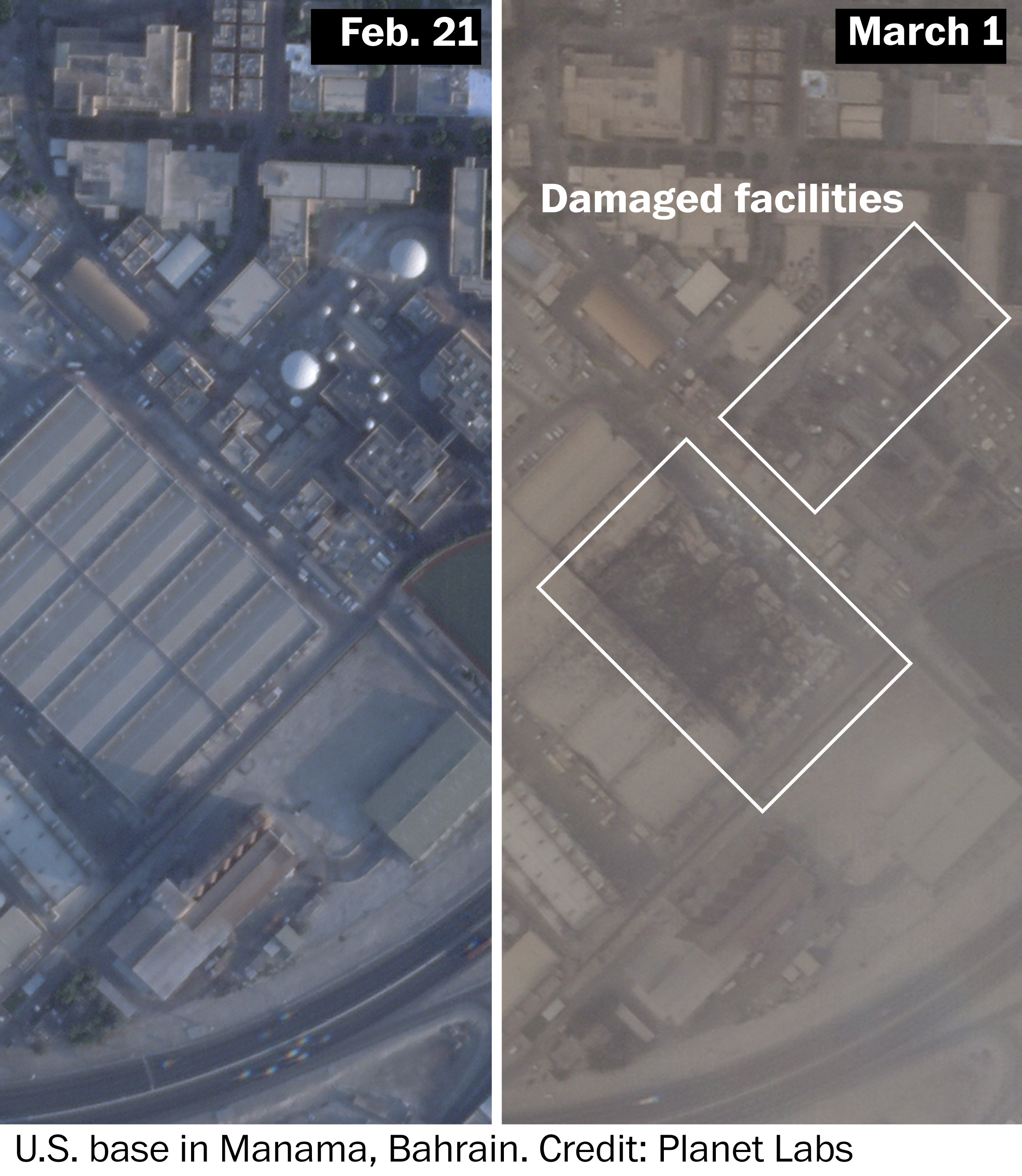

Planet imagery and verified video showed a major building and two satellite-communications radomes destroyed at Naval Support Activity Bahrain; later imagery showed another damaged building. The Navy did not initially provide a full damage inventory. AP satellite analysis ↗ New York Times visual investigation ↗
The spherical structures were protective radomes around AN/GSC-52B military satellite-communications terminals—not conventional search radars. Later reporting, citing a CSIS estimate, valued each destroyed terminal at approximately US$20 million, or roughly US$40 million for the pair. A separate reconstruction estimate placed the damaged Bahrain base structures at about US$400 million, but that larger figure excluded specialised communications equipment, debris clearance and future hardening. These are replacement and reconstruction estimates, not a publicly released Pentagon damage bill. Cost reporting ↗ System and reconstruction detail ↗
Iranian outlets described damaged warehouses, a service centre, fuel-related infrastructure and logistics facilities, presenting the strike as proof that naval command infrastructure had been penetrated. IDNFinancials repeated the stronger formulation that the headquarters had been “destroyed”; the imagery supports severe and extensive damage, but not the literal destruction of every headquarters function. IDNFinancials report ↗
Damage at the base is independently established. March imagery alone could not demonstrate the full operational effect or assign a precise function to every damaged structure. Later Navy reporting, the relocation of headquarters functions and the acting Navy secretary's reported remarks establish substantial disruption to normal base and carrier-support operations. The duration of that disruption, the status of every subsystem and claims of complete or permanent capability loss remain unresolved. Washington Post investigation ↗ Navy Times — operational consequences ↗
Naval Support Activity Bahrain is the shore headquarters for the U.S. Fifth Fleet and a central node for naval activity across the Persian Gulf, Arabian Sea and nearby waterways. The visible loss of communications radomes was therefore more consequential than ordinary roof damage: the AN/GSC-52B terminals identified by visual investigators support high-capacity military satellite communications. The strike pattern is consistent with an attempt to interfere with command connectivity rather than simply hit a symbolic American address.
The photographed damage did not prove that Fifth Fleet command-and-control ceased. Military networks are built with alternate links and relocatable functions, and the early public record did not show how quickly those alternatives were used. Later reporting that headquarters functions moved to MacDill Air Force Base supports the view that the impact was serious, but it still does not validate every Iranian claim about warehouses, stored matériel or permanent loss of capability.
United Arab Emirates · Abu Dhabi
A July report citing Sentinel-2 imagery said visible U.S. aircraft had fallen to zero by 24 July. An empty flight line can indicate dispersal and does not prove that the base, its host-nation operations or its support staff were abandoned. No reviewed authoritative source confirms a complete evacuation or defines a remaining skeleton crew. Review the imagery claim ↗
Iranian state-linked reporting carried a claim that dozens of long-range one-way attack or “kamikaze” drones were launched against radar systems and locations housing U.S. forces at Al Dhafra and Al Minhad air bases at approximately 06:30 GMT. The number reportedly launched is not a count of successful impacts. At the time of the claim, the UAE had not confirmed this reported wave, and no independently verified imagery established new damage, casualties or operational interruption at either installation. The UAE had denied a separate Al Minhad strike claim two days earlier after acknowledging that it intercepted an Iranian drone over its territorial waters; that earlier denial does not resolve this later claim but demonstrates the need to distinguish a launch assertion from a verified base impact. Iranian claim carried by Caliber.Az ↗ AP — earlier UAE interception and denial ↗ GlobalMilitary — Al Minhad profile ↗
During what it called the 31st phase of Operation Saeqeh (“Lightning”), Iran's army claimed that missiles and drones struck U.S. troop positions and radar systems at Al Minhad Air Base. The statement identifies a target and alleged effects, but it is not evidence that the weapons reached the base. No reviewed UAE or U.S. statement, independently verified imagery, casualty report or operational notice corroborates an impact or damage from this 3 September claim. The UAE's denial cited below concerned the separate 31 August episode and should not be misdated as a response to this later assertion. AFP-carried Iranian claim ↗
The UAE Defence Ministry said it dealt with an Iranian drone approaching over territorial waters and separately rejected Iran's claim that Al Minhad Air Base had been attacked. This does not disprove every later Iranian launch claim involving the UAE, but it means no successful Al Minhad impact should be recorded without new independent evidence. No host-government or independently verified report reviewed for this update confirms new damage at Al Dhafra during the 1–3 September exchange. Associated Press ↗
Iran attacked the UAE with both missiles and one-way attack drones, but the reviewed imagery does not reliably match an individual weapon to the damaged Al Dhafra hangars, compound or alleged fuel site. Burned and shredded roofs establish impact effects; they do not by themselves distinguish a ballistic-missile warhead, drone warhead or secondary fire. AP damage assessment ↗
CENTCOM acknowledged that U.S. personnel were wounded in the United Arab Emirates during the wider campaign, but no reliable public source reviewed for this page gives a death or injury count specifically for the strikes on Al Dhafra. Countrywide UAE civilian and military casualty totals should not be attributed to this base. Regional U.S. casualty reporting ↗


Imagery later analysed by AP showed damage to northwestern hangars, a southeastern hangar apparently burned through, and roof damage to an adjacent hangar. Earlier imagery also showed a compact compound heavily damaged. AP satellite analysis ↗ New York Times visual investigation ↗
Circulated comparisons labelled the targets as troop housing, barracks and fighter-jet fuel storage, implying disruption to sortie generation and base logistics.
Physical damage at Al Dhafra is verified. The contents and precise uses of the struck hangars were unclear, so claims that designated fuel or housing infrastructure was destroyed remain unproven from the supplied images.
Al Dhafra has supported U.S. surveillance, tanker, fighter and remotely piloted aircraft operations. That makes hangars, fuel systems and communications compounds plausible targets. The comparisons circulated on March 10 show darkened roof areas, missing roof sections and disturbed ground at several locations. Later higher-quality imagery strengthened the conclusion that multiple hangars were struck or burned, including one whose roof appeared extensively shredded by fire.
The source graphics nevertheless move too quickly from visible damage to specific function. A rectangular tank-like structure is not proof that it held fighter fuel at the time of impact, and a group of modular buildings cannot be identified as American troop housing from overhead appearance alone. The strongest finding is that aviation-support areas suffered damage; the claimed contents, quantities destroyed and effect on sortie rates remain unresolved.
Qatar · southwest of Doha
Some personnel were advised to evacuate before the war, with reporting that troops were moved to hotels and other facilities in the region. A later imagery-based report claimed that visible U.S. aircraft had dropped to zero by 17 July. Together this supports a dispersed and reduced posture, but not a verified total withdrawal: aircraft can relocate while command, maintenance and security functions continue. No reviewed source provides a current headcount or skeleton-crew figure. Associated Press ↗ Axios ↗ July aircraft claim ↗ Pentagon footprint assessment ↗
The damage occurred during Iranian missile-and-drone attacks, but the public satellite record does not conclusively connect a particular weapon to the damaged Al Udeid communications area or the Umm Dahal radar. Claims that a specific ballistic missile destroyed the radar remain less certain than the visible physical damage itself. No reviewed source identifies an FPV strike here. New York Times visual investigation ↗
Qatar said two missiles reached Al Udeid and a drone targeted an early-warning radar on 28 February, with no casualties at those military sites. Eight people were injured elsewhere in Qatar by falling fragments during the broader barrage; those injuries are not attributed to Al Udeid. Qatari government statement ↗


Independent analysis found damage to a building at Al Udeid and destruction of a tent amid satellite dishes, with some dishes likely damaged. Separate imagery showed damage to the AN/FPS-132 radar site at Umm Dahal, north of the air base. AP satellite analysis ↗ New York Times visual investigation ↗
A widely shared ground-level image purporting to show the Qatari radar destroyed was AI-generated. That false image does not negate the separate satellite evidence of damage. AFP fact check ↗
Damage at Al Udeid and at the associated radar site is supported. Iranian captions claiming a complete communications or logistics shutdown are not established by the available imagery.
The dated evidence reviewed here supports physical damage at Al Udeid, but does not establish a new October strike. A photograph newly published or recirculated is not necessarily newly captured. Publication date, image acquisition date and the interval in which damage appeared must be kept separate. The specific newly circulating images have not yet been identified and authenticated for this review.
Bellingcat’s 7 April investigation compared Sentinel-2 imagery from 22 February and 14 March. It identified a darkened area on the roof of a warehouse-like building at Al Udeid, corresponding to a potential-damage signal in its Sentinel-1 radar analysis. This provides an independently published observation of visible change during that interval; it does not identify the contents of the building or establish the exact attack date. Bellingcat — imagery comparison and methodology ↗
Al Jazeera’s June review identified April imagery showing damage to logistics, shelter and accommodation facilities at Al Udeid. Al Jazeera — dated satellite review ↗
In a separate 5 June investigation, Air & Space Forces Magazine reported that multiple Iranian missiles had severely damaged Al Udeid’s Combined Air Operations Center during the opening weeks of the war, leaving that facility inoperable. Its account cited a senior U.S. official and other people informed about the attack. It reported no injuries because the centre was not in use, and said air-campaign command had already shifted to Shaw Air Force Base in South Carolina. CENTCOM declined to comment. These are attributed reporting findings, not conclusions drawn from the satellite photographs. Air & Space Forces Magazine — command-centre investigation ↗
Damage to an individual command facility does not demonstrate the closure of the whole base. Neither the dated images nor the June account establishes its October repair status, present staffing or current sortie capacity. A later strike needs a separately dated record rather than being inferred from older destruction. No additional casualty figure, aircraft loss or base-wide shutdown is established by this review.
Radar change detection is a lead for investigation rather than a photograph of destruction. Bellingcat cautions that its damage-proxy map requires comparison with other evidence and is not a real-time damage record. For newly released pictures, a useful assessment therefore needs the original provider, capture date and a comparable earlier view, followed by corroboration of the claimed operational consequences. Read the satellite method and limitations ↗
Reporting about Qatar sometimes blurred Al Udeid itself with the AN/FPS-132 early-warning radar at Umm Dahal to its north. They are related to the same regional defence architecture but are not the same facility. At Al Udeid, imagery indicated damage around satellite dishes and a communications structure. At Umm Dahal, analysts identified damage to the large phased-array radar installation used to detect and track ballistic missiles.
Striking both communications and warning infrastructure would have a clear operational logic: reduce the speed with which an incoming launch is detected, interpreted and shared. But physical damage does not show whether the wider radar picture disappeared. The United States and its partners can draw on airborne sensors, satellites, ships and other regional radars. Likewise, images of a damaged logistics building cannot establish that Al Udeid—an enormous base with distributed facilities—was rendered inoperable.
Jordan · evidence reviewed 9 October 2026
The strongest reviewed evidence concerns the attack overnight on 8–9 September. It combines reporting about aircraft condition with dated satellite analysis. These sources address different questions: overhead images can reveal structural changes, while the reported aircraft assessment describes damage that may not be identifiable at that resolution.
Air & Space Forces Magazine reported a severely damaged wing on one A-10 and light damage to approximately eight F-15E fighters, citing people familiar with the assessment. The F-15Es were considered serviceable. U.S. officials said no American personnel were killed in this attack; CENTCOM had not responded to the magazine at publication. The report supports a material loss of capability for the affected A-10, but does not establish its final repairability or that nine aircraft were destroyed. Air & Space Forces — 9 September aircraft assessment ↗
The Defense News reproduced OSINT analysis of Sentinel-2 imagery dated 10 September, identifying apparent changes around a taxiway and aircraft shelters. These are analysts’ interpretations of the imagery, not a U.S. military damage inventory. The public optical data cannot reliably identify individual damaged aircraft, shelter contents or the weapon used. Separate counts of four apparent impacts and six suspected changes must not be added together: they may describe overlapping features using different methods. Published imagery and attributed OSINT analysis ↗

The reviewed September material does not establish October repair progress, current aircraft strength, base-wide closure or a fresh October strike. Images of damaged helicopters circulating separately are not assigned to this event without verified location and capture dates.
Kuwait
Before the opening attacks, the Pentagon moved troops away from some large regional bases and dispersed them among smaller facilities. On-the-ground accounts confirm that personnel, including essential staff, remained in the Kuwait network during attacks and subsequent evacuations. The current Air Mobility Command terminal page also describes a daily shuttle connecting Camp Arifjan, Ali Al Salem and Camp Buehring, which is inconsistent with all three being abandoned. Public sources still do not provide reliable current headcounts, and services can be reduced or suspended faster than public pages are updated. A Pentagon assessment is considering a smaller future Kuwait presence; that is a proposal, not evidence that the bases have already closed. Personnel accounts ↗ Air Mobility Command shuttle ↗ Washington Post, 18 August ↗
Kuwait's armed forces said air defences were engaging and intercepting hostile Iranian missiles and drones early on 3 September, during a second consecutive night of attacks. Kuwait also reported that a drone struck a residential complex in Kuwait City, causing a small fire that was contained without casualties. That civilian impact is separate from the later imagery finding at Ali Al Salem. Iranian state broadcasting said U.S. bases in Kuwait were the targets, while local-source claims carried by Iranian media alleged that a U.S. site had been hit and smoke was visible. Neither Kuwait nor the United States has publicly confirmed U.S. casualties or issued a damage inventory for Ali Al Salem. The renewed attack and defensive engagement are documented; later commercial imagery now supports substantial structural change at the base, while the weapon, occupancy and operational effects remain unresolved. Associated Press ↗ Kuwaiti defence statement reported by AFP ↗ Contemporary impact claim ↗
Iran's army claimed that missiles and drones struck satellite-communication systems, equipment depots and fighter-aircraft hangars at Ahmad Al-Jaber Air Base during the 31st phase of Operation Saeqeh (“Lightning”). This is a distinct target claim within the already documented second-night Kuwait attack wave, not independent confirmation of additional successful impacts. Neither Kuwait nor the United States has corroborated the alleged base damage. A later low-resolution MizarVision graphic marks three possible changes in the aircraft-parking area, but it cannot verify the claimed targets, establish damage or attribute the features to Iranian weapons. AFP-carried Iranian claim ↗ Provisional imagery report ↗
A MizarVision assessment reproduced by The Defense News highlights three dark features in Ahmad Al-Jaber's aircraft-parking area and three marks on the roof of a large building in Ali Al Salem's billeting area. The graphic is included for transparency, but the available resolution does not show whether the features are craters, roof penetrations, scorch marks, shadows or unrelated changes. It also does not show damaged aircraft or identify the building's occupants. These six annotations are therefore not added to the verified strike count. Report and source graphic ↗
At approximately 06:10 GMT, the IRGC claimed that a combined missile-and-drone attack on Ali Al Salem Air Base hit the headquarters and accommodation of the U.S. commander, set fire to a drone hangar and operating ramp, destroyed several U.S. drones and killed an unspecified number of personnel. New imagery strengthens the case that buildings were damaged, but it does not validate those more specific descriptions, establish that the structures housed the commander, show aircraft losses or confirm casualties. Those details therefore remain attributed Iranian claims. IRGC claim reported by Anadolu ↗ AP — Kuwaiti interception context ↗
A newly circulated Soar-sourced commercial comparison shows two structures in the U.S.-used accommodation area present on 25 August but destroyed or removed by 3 September: one appears reduced to rubble and the second as a partly cleared debris pad. The timing and location are consistent with the reported 2 September Iranian attack, making strike damage a credible explanation. The images establish physical change, but do not by themselves prove the buildings were occupied, identify their exact function, establish the weapon used or confirm casualties. Neither CENTCOM nor Kuwait has publicly issued a matching damage assessment, and the available date bracket does not completely exclude demolition or another cause. EnergyWar therefore treats the structural change as imagery-supported and the causal attribution as probable, while leaving Iran's command-facility, drone-loss and casualty claims unverified. Imagery report and comparison ↗ Regional report carrying the comparison ↗
Kuwait saw several distinct attack types. Verified footage showed a long-range Iranian one-way attack drone diving into Camp Buehring, and U.S.-sourced reporting said an Iranian F-5 fighter penetrated at low altitude and bombed the camp during the opening phase. Iran later claimed Arash kamikaze-drone strikes on Buehring, Ali Al Salem and Camp Arifjan; the specific July damage claims were not independently confirmed. Earlier damage to Ali Al Salem buildings, Arifjan radomes and Buehring infrastructure came amid mixed missile-and-drone salvos, so exact weapon-to-impact attribution remains incomplete. NBC verified drone footage ↗ Reported F-5 raid ↗ Attributed Arash claims ↗
At least 15 Americans were injured, most lightly, in an Iranian drone strike on Ali Al Salem on 6 April. No reliable base-specific casualty figure was found for the attacks assessed here at Camp Arifjan or Camp Buehring. Six U.S. troops killed in Kuwait on 1 March died in a separate drone strike on an operations centre at Port Shuaiba, not at any of these three bases. Ali Al Salem injuries ↗ Port Shuaiba distinction ↗
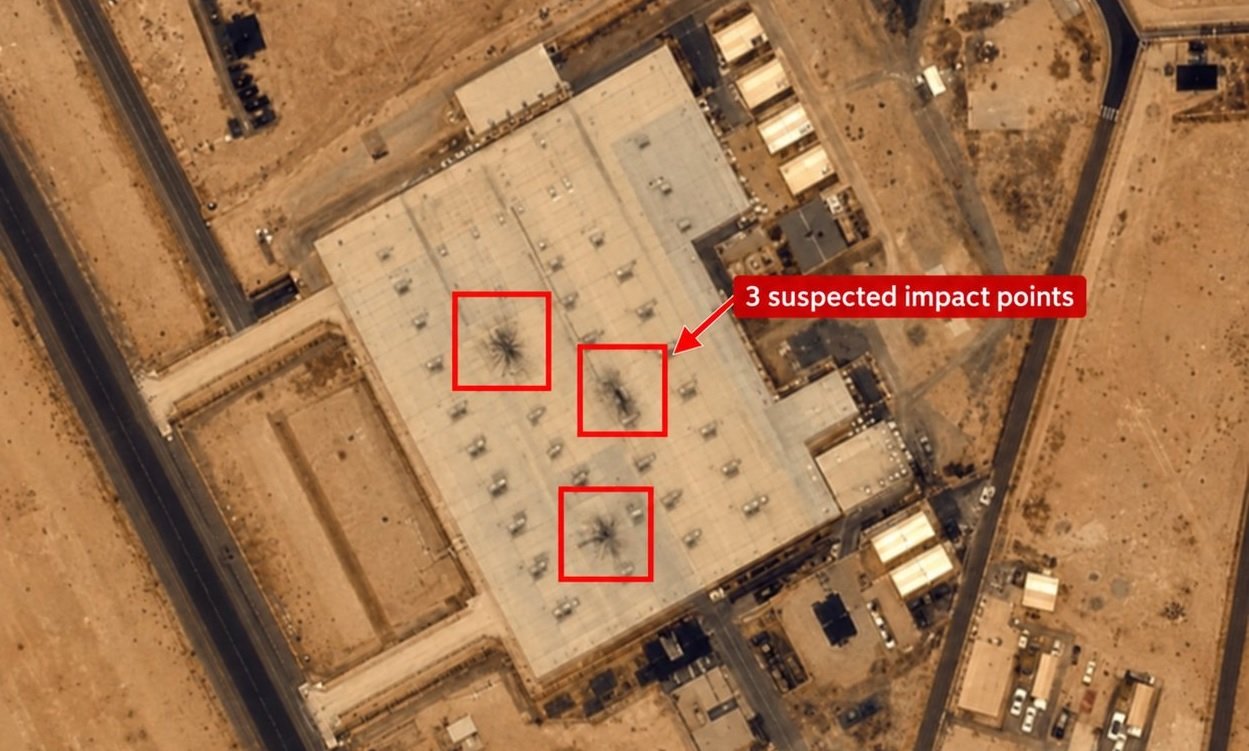
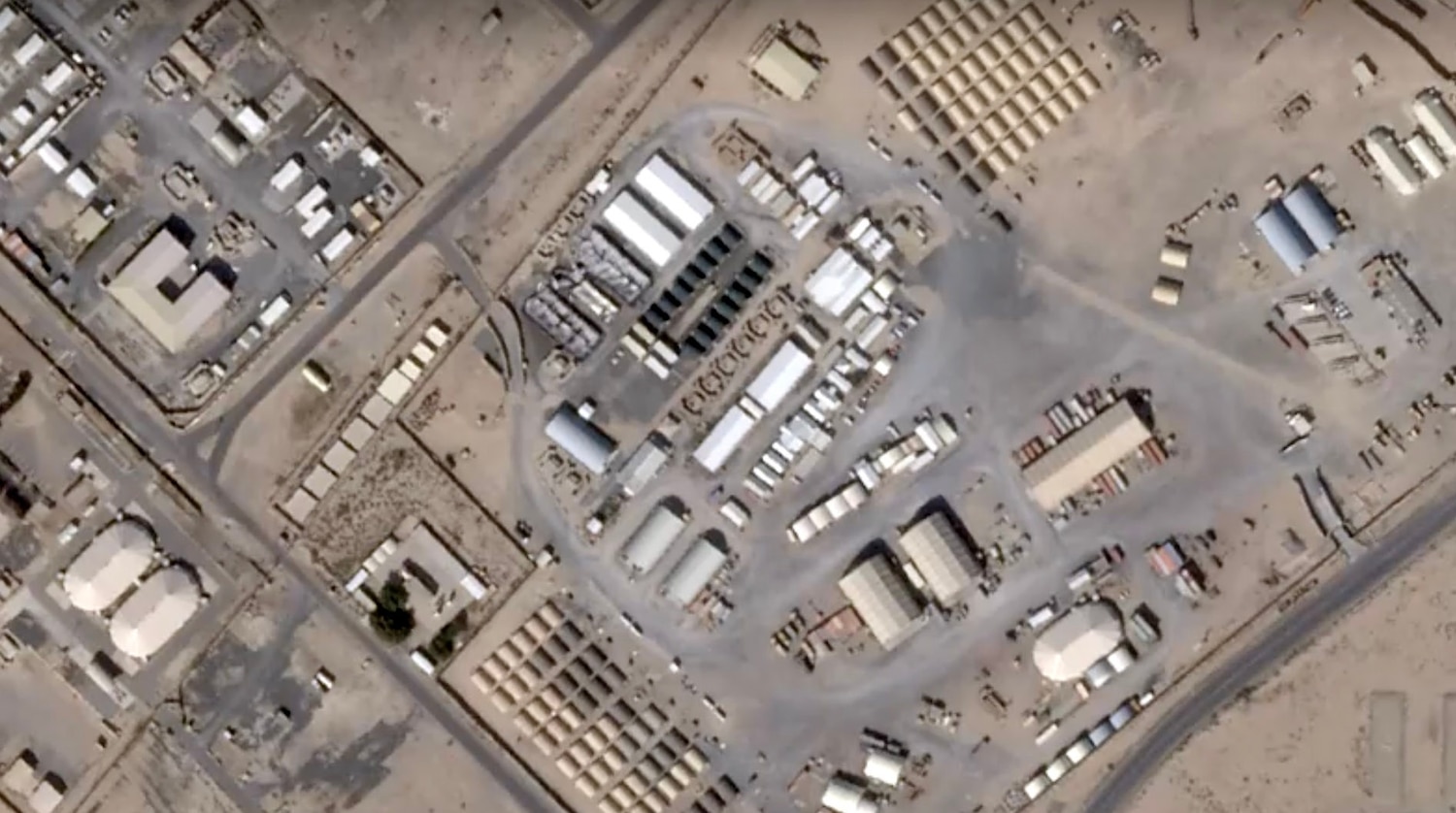
Satellite imagery showed multiple buildings damaged at Ali Al Salem. At Camp Arifjan, at least three radomes were damaged or destroyed; lower-resolution analysis also indicated damage at Camp Buehring. ABC News visual verification ↗ New York Times visual investigation ↗
Iranian state-linked releases grouped Kuwait into a wider campaign against American facilities, often without publishing capture times, satellite provenance or enough context to evaluate each marked impact.
The supplied Defence Security Asia article did not identify the Kuwaiti facilities by name. Independent reporting supports damage at these three locations, but low-resolution evidence limits the count and severity assessment at Camp Buehring.
Damage across Kuwait’s U.S.-used network is supported by satellite reporting, but the evidence varies by facility and date. ABC’s 3 March visual investigation found visibly damaged buildings at Ali Al Salem in 1 March imagery. Its assessment of Camp Arifjan and Camp Buehring used lower-resolution imagery, supporting the presence of damage more strongly than an exact inventory of destroyed equipment. The images below cover different episodes and must not be presented as one simultaneous attack. ABC — satellite investigation and image provenance ↗
AP’s 5 October investigation revisited the drone strike that killed six soldiers at Port Shuaiba. It reported concerns from soldiers and families about protection and leadership decisions, citing personnel familiar with the planning. These are investigative findings about an earlier attack, not evidence of new October casualties. Port Shuaiba is distinct from Ali Al Salem, Camp Arifjan and Camp Buehring; its losses must not be assigned to those bases. AP — soldiers and families press Army leadership, 5 October ↗
In a separate 5 October investigation, nine wounded service members spoke on the record to AP about difficulties obtaining treatment after the Port Shuaiba attack. Their accounts describe problems with evacuation, admission and follow-up care. These are attributed accounts of the medical response, not a new casualty count or a finding that every wounded soldier received inadequate care. AP — wounded soldiers describe medical-system failures ↗
AP’s accompanying family reporting also describes lasting injury and bereavement. The Army told AP it had not yet briefed bereaved families on the investigation’s outcome. That statement is dated to the October reporting; it does not establish the investigation’s current publication status. AP — families and long-term consequences ↗
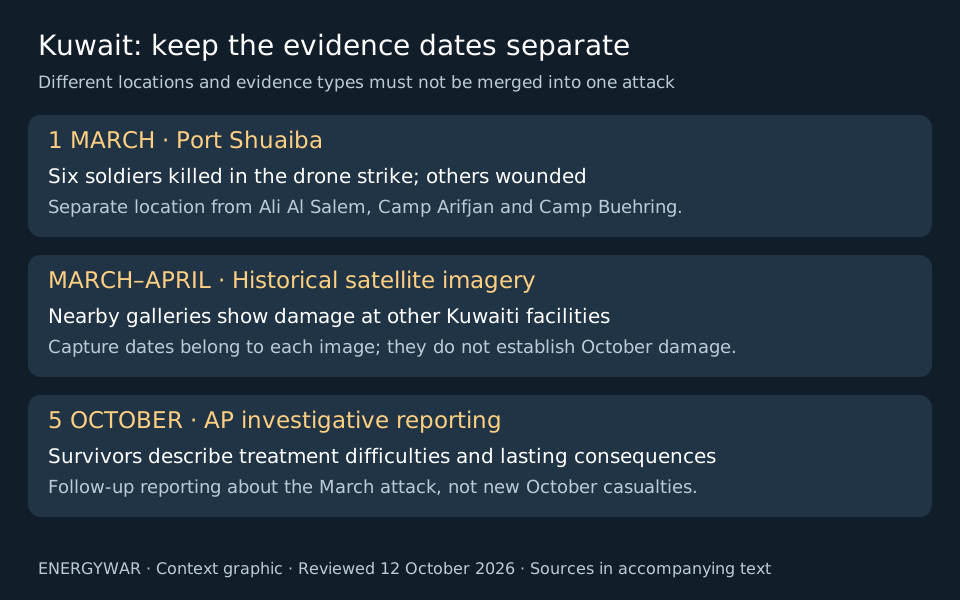
Assessment: a complete account of a base attack should distinguish immediate deaths and wounds, subsequent treatment, lasting disability and the official investigation. Satellite imagery can establish some structural changes, but cannot measure those medical outcomes. This update establishes no new October strike, additional fatality total or newly verified satellite damage.
Roof loss, debris and changes around communications structures support physical damage. They do not alone show the number of personnel inside, equipment contents, repair costs or how long a function was unavailable. Claims about destroyed drones, command accommodation and fatalities remain separately attributed where no matching independent assessment exists. No new October strike or current base-wide shutdown is established by this review.
Kuwait’s importance comes from the combination of air operations and ground-force logistics. Ali Al Salem supports coalition aviation, while Camp Arifjan and Camp Buehring have served as staging, sustainment and transit hubs for American forces. Damage across all three would indicate an effort to reach beyond a single prestige target and pressure the infrastructure used to move personnel, equipment and information through the northern Gulf.
The clearest Kuwaiti evidence concerned damaged buildings near satellite equipment at Ali Al Salem and damaged or destroyed radomes at Camp Arifjan. The Camp Buehring assessment relied on lower-resolution imagery, so it supports the presence of damage more strongly than it supports a precise count. Claims of wholesale base destruction are not justified by the reviewed material.
Saudi Arabia
Public reporting does not support calling Prince Sultan abandoned or reduced to a skeleton crew. In fact, one postwar policy proposal discussed by officials would consolidate some forces there because it lies farther west than the most exposed Gulf installations. The proposal was still under assessment in August and does not prove that such a move occurred. Pentagon footprint assessment ↗
U.S. officials said the 27 March attack involved an Iranian missile and drones. Several refuelling aircraft were damaged; later imagery appeared to show an E-3 Sentry and tanker aircraft destroyed or heavily damaged. The Pentagon inspector general's later regional aircraft table classifies one E-3 as damaged and five KC-135s as damaged or destroyed on the ground in Saudi Arabia, without naming their airfield. That official classification should be read alongside the visual assessment, not converted into a Prince Sultan-specific aircraft count. Earlier imagery also showed a destroyed structure near a radome, while later analysis identified runway, tarmac and adjacent-building damage. The record supports a coordinated missile-and-one-way-drone attack, not a specifically verified FPV strike. AP report ↗ Satellite damage analysis ↗ Pentagon inspector-general aircraft table ↗
One U.S. service member died on 9 March from wounds suffered in an earlier 1 March attack on Prince Sultan Air Base. Later reporting put the 27 March strike toll at at least 15 U.S. service members injured, including two seriously wounded. Fatality reporting ↗ 27 March injuries ↗

After the IRGC announced that it had targeted the base, imagery showed a long smoke plume from a structure in a fenced communications area east of the main base; later imagery showed the structure largely destroyed. AP subsequently reported damage visible in a March 15 image. New York Times visual investigation ↗ AP satellite analysis ↗
Iranian releases portrayed the Saudi strike as part of a region-wide ability to penetrate defences around the American military footprint.
A strike and structural damage are supported. The exact function of the destroyed building and the wider operational effect were not publicly established in the reviewed sources.
The damaged Saudi structure was separated from the main flight line in a fenced area near a radome. Its location makes a communications or sensor-support role plausible and fits the broader regional emphasis on information infrastructure. A smoke plume followed by imagery of a largely destroyed building provides a strong temporal indication of a strike, even though overhead imagery alone cannot identify the equipment inside.
Prince Sultan Air Base has supported U.S. air and missile-defence activity, giving the strike both practical and political significance. Later imagery supports the destruction or severe damage of an E-3 Sentry and tanker aircraft, in addition to airfield and structural damage. The available evidence does not establish that the main runway closed or that the base lost its overall operational mission.
Additional imagery in the source article · Iraq
These three before/after comparisons also appear in the Defence Security Asia article. Erbil was not one of the five country groupings requested for this assessment, so the images are retained here for completeness without folding them into the Gulf-base findings above. Their labels and target identifications are Iranian-media claims and have not been independently verified for this page.


These images illustrate the central verification problem especially well. The alleged changes are visually legible, but the “Patriot site,” “helicopter hangar” and “operations center” labels are assertions embedded in the graphics rather than conclusions demonstrated by them. Without original capture dates, coordinates and an independent comparison series, the images can be documented as part of the information campaign but should not be used alone to quantify damage at Erbil.
Source notes
The Defence Security Asia article correctly warned that its imagery lacked metadata and independent validation. Reporting published afterward documented physical damage or imagery changes consistent with attacks across all five country groupings covered here, while also demonstrating why individual overlays must be treated cautiously: authentic satellite scenes, unsupported facility labels and an AI-generated Qatar image circulated together.